7 Mistakes Alaska Business Owners Make When Selling
Drawn from years of underwriting acquisitions on the buy side and from conversations with Alaska owners who have been through the process. None of these are theoretical. All of them cost real money when they happen.
1. Treating valuation as a wish instead of a calculation
Most owners walk into a sale with a number in their head: the number they need to retire, or the number a neighbor sold for. Neither is a valuation. They are wishes.
Real valuation starts with normalized EBITDA, then applies a multiple. For most Alaska small businesses in the $250K to $20M revenue range, that multiple lands between 2.5x and 5x. If you do not know your normalized EBITDA before you go to market, the buyer will calculate it for you, and they will not be generous.
2. Preparing tax returns but not preparing for due diligence
Tax returns minimize taxable income. Due diligence packages maximize provable earnings. These are different documents prepared with opposite goals.
Buyers expect monthly P&Ls going back 36 months, a customer concentration analysis, and clean separation between business and personal expenses. Most Alaska small businesses do not have these on day one. The work takes 3 to 6 months if you start before going to market. It takes much longer, and erodes your negotiating position, if you start once a buyer is already at the table.
3. Tying the business to yourself in ways buyers cannot unwind
Buyers are not buying your business. They are buying the cash flows it will produce after you leave. If those cash flows depend on you personally, your customer relationships, your operational knowledge, your decisions, then the buyer is buying a job, not an asset.
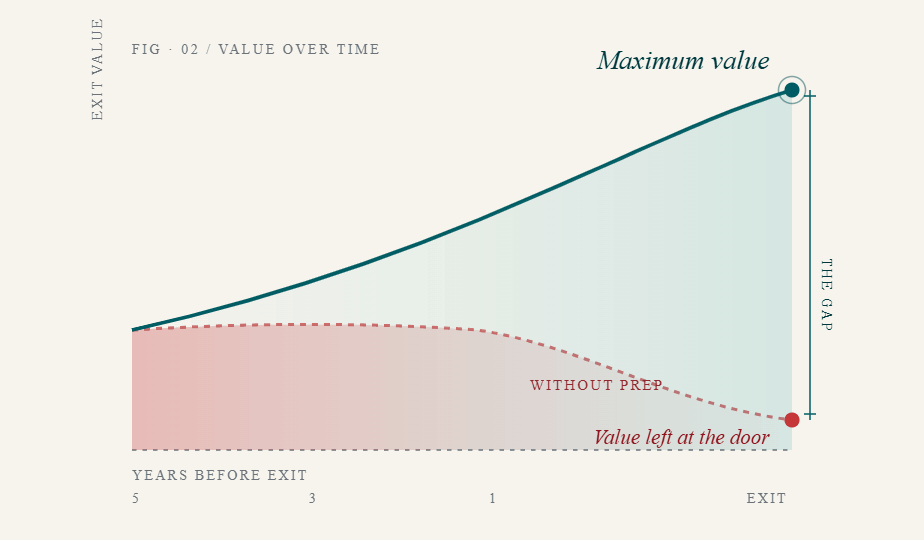
When the answer to who owns the top customer relationships is the owner, the multiple drops by a full turn or more. Reducing owner-dependence takes time. Owners who plan their exit 18 to 36 months out can materially change their multiple. Owners deciding in month one cannot.
4. Treating exit planning as only a business decision
A maximum-value exit sits where three plans meet: your personal plan (what you do next), your business financial plan (how the company is positioned), and your personal financial plan (what you need after close to fund the life you want).
Owners who optimize one and ignore the other two leave money or peace of mind on the table. The business sells but you have no idea what to do on Monday. The price is right but the after-tax proceeds do not fund retirement. The business gets cleaned up but no one asks what you actually want from the next chapter. All three matter.
5. Negotiating with the first buyer instead of running a process
The first buyer who approaches you is rarely your best buyer. They are simply the most aggressive one, and their willingness to pay top of market depends almost entirely on whether they think other buyers are competing.
A real process means engaging an advisor, identifying 30 to 100 qualified buyers, and creating a structured timeline. The premium from running a process is typically 15 to 40 percent above what you would have accepted from the first buyer. For an Alaska business worth $5M, that is $750K to $2M of additional value, which more than covers any advisor fee.
6. Saying yes to seller financing without modeling the risk
Seller financing, where you accept a note for part of the purchase price paid out over time, is common in small business sales. It can be a useful tool. It can also turn a sale into a multi-year exposure to a buyer's mistakes.
What collateral secures the note? Are the personal guarantees real or theatrical? In what order do you get paid relative to the bank debt the buyer takes on at close? Owners who do seller financing without a transaction attorney and a tax-aware CPA are accepting risk they have not modeled.
7. Underestimating how long the close actually takes
Most Alaska small business sales take 12 to 18 months from the decision to sell to the wire transfer at close. That includes preparation, going to market, and signed-LOI through close.
Owners often plan their next chapter on a much shorter timeline. Then due diligence takes longer than expected, financing falls through, or working capital negotiations drag. The fix is not a faster process. The fix is planning your life around the realistic timeline. Owners with 18 to 24 months of runway make better decisions throughout. Owners on a hard deadline negotiate from weakness.
Every one is fixable, but not alone, and not at the last minute
Start with the free 7-lesson course to get oriented, book a session with an advisor if a buyer has already reached out, or talk to us about running the preparation with you. We are meant to be the step before you go to market.
Where to go from here
Start with the free 7-lesson course, or book a session with an advisor if you have a live situation.